

:
| Mistake Number | Description |
|---|---|
| 1 | Ignoring Ceiling Height: A fan that is too low can be unsafe, and a fan for a short ceiling may not move enough air in a tall warehouse. |
| 2 | Overlooking Obstructions: Not thinking about things in the way can make airflow bad and the fan not work well. |
If you know the technical details, you can stop these problems and choose the right fan with confidence.
Key Takeaways
Know what your project needs before picking a fan. Think about the size of the room and what it needs.
Check the ceiling height and look for things that block air. This helps the fan work well.
Find fans with the right certifications. This makes sure they are safe and follow rules.
Use fan catalogs to compare models. Look at airflow (CFM), static pressure, and noise levels.
Look at installation needs. Measure your space and make sure the fan fits. Check for things that might block it.
Regular maintenance is important. Follow the manufacturer’s instructions to keep your fan working safely and well.
Write down your choices. Keep notes about your needs, comparisons, and which fan you picked.
Pick a good manufacturer with strong warranties and support. This keeps your fan safe and reliable.
Define Your Project Needs
You should know what your before you look at Ventilation Fan Catalogs. This step helps you avoid mistakes. It also makes picking a fan much easier. Let’s look at the main things you need to think about.
Airflow and Application
First, think about the space you want to ventilate. Is it a house, a kitchen, a warehouse, or a hospital room? Every space needs something different. For example, factories need to get rid of heat from machines. Bathrooms need to keep moisture under control. You should pay attention to these important things:
How much money you can spend
The table below gives more details about what matters when you choose:
| Key Factors | Description |
|---|---|
| Required airflow (CFM rating) | How much air needs to move each minute. |
| Total floor area and ceiling height | The size and height of the space change how air moves. |
| Heat output from machinery | Machines make heat that must be removed. |
| Air changes per hour (ACH) | How often the air in the room should be replaced. |
| Operating hours per day | How long the fan will run each day. |
| Energy efficiency targets | Goals for saving energy and using it well. |
| Environmental exposure conditions | Things like humidity and temperature affect how the fan works. |
| Noise control requirements | You may need the fan to be quiet. |
SanLi Appliances has many products for different places. You can find fans for homes, offices, factories, and hospitals. This makes it easier to pick the right fan for your needs.
Space and Installation
You need to measure your space before you pick a fan. Ceiling height, floor area, and walls or equipment change how air moves. If your warehouse is tall, you need a fan that moves lots of air. In a small bathroom, a small fan is enough. Think about where you will put the fan. Some fans go on ceilings. Others go on walls or inside ducts. SanLi Appliances has fans for all these places, like inline duct fans and ceiling exhaust fans.
Tip: Always look for things like beams or shelves that block airflow. This helps you avoid problems after you install the fan.
Certification and Compliance
When you pick a fan, make sure it meets safety and quality rules. International certifications show the product is safe and works well. Here is a table of common certifications and what they mean:
| Certification | Region | Importance |
|---|---|---|
| ATEX | EU | Needed for equipment in places with explosive air |
| IECEx | International | Accepted everywhere for explosive air |
| ISO 9001 | Global | Shows the company cares about quality |
| ISO 14001 | Global | Shows the company follows environmental rules |
| ISO 45001 | Global | Makes sure workers are safe and healthy |
SanLi Appliances has many of these certifications. You can trust their products for projects in different places. Always check Ventilation Fan Catalogs for certification marks. This helps you follow your local rules.
Navigating Ventilation Fan Catalogs
When you look at , you need to know what to do. There are lots of pages with many products and numbers. You will also see guides that help you. If you learn how to use these catalogs, you can make better choices for your project.
Product Categories and Series
Ventilation Fan Catalogs put products into groups and series. You will find different fans for different jobs. For example, SanLi’s catalog has many options. The table below shows some types you might see:
| Product Category | Examples |
|---|---|
| Duct Fans | AC Mixed Inline Duct Fan, EC Mixed Inline Duct Fan, Plastic Duct Fans, etc. |
| Blowers | Air Movers & Blowers, Exhaust Blowers, Floor Blowers, etc. |
| Exhaust Fans | Bathroom Fans, Industrial Exhaust Fans, Wall Exhaust Fan, etc. |
| Commercial Fan & Blower | DDM Centrifugal Blower, AT Centrifugal Blower, REM Centrifugal Blower, etc. |
| Motors & Drive System | AC Motors |
You should check which series match your project. Some fans are good for homes. Other fans are made for factories or offices. SanLi Appliances has many fans for different places.
Key Specifications Overview
You need to look at the main details when you compare fans. These things help you pick the best fan for your needs. Here are the most important things to check:
: Find out how much air you need to move each minute (CFM).
Static Pressure: Check how much resistance your ducts and filters create.
Operating Environment: Think about temperature, humidity, and any dust or chemicals in the air.
Efficiency Goals: Look for fans that save energy and lower your costs.
Compliance Needs: Make sure the fan meets safety and environmental rules.
Tip: Write down what your project needs before you look at the details. This makes it easier to compare fans.
Selection Guides and Manuals
Ventilation Fan Catalogs have guides and manuals to help you. These papers explain how to pick the right fan and how to put it in. The table below shows what you might find:
| Type of Guide/Manual | Purpose |
|---|---|
| Technical Guides | Give detailed specifications and instructions for using fans. |
| Datasheets | Show numbers like CFM and energy use. |
| Product Documents | Include installation steps and warranty details. |
| Sizing Charts | Help you pick the right fan size for your room. |
| Technical Articles | Teach you about air quality and humidity control. |
SanLi’s catalog gives you all these tools. You can use them to make sure you pick a fan that fits your space and works for you. If you read the guides and check the details, you will feel sure about your choice.
Interpreting Spec Sheets
Understanding is important for choosing the right fan. You need to know what each number and term means. This helps you match the fan to your project and avoid mistakes. Many spec sheets use technical words. If you learn these, you can compare fans with confidence.
CFM and Static Pressure
CFM stands for Cubic Feet per Minute. This number tells you how much air the fan moves in one minute. For example, a fan with 5 CFM can move all the air in a small box (5 ft x 5 ft x 5 ft) in 25 minutes. Static pressure shows how much force the fan uses to push air through ducts or filters. You will see static pressure measured in Pascals (Pa) or inches of water (inH2O). .
You should know that airflow and static pressure work against each other. If you pick a fan with high CFM but low static pressure, it may not work well in a system with many bends or filters. Always , not just the highest CFM.
:
| Fan Type | CFM Characteristics | Static Pressure Suitability |
|---|---|---|
| Axial Fans | Large air volumes at low pressures | Not suitable for high static pressure environments |
| Centrifugal Fans | High efficiency at high static pressures | Well-suited for ductwork with many bends and high resistance |
| Mixed-Flow Fans | Moderate static pressures with acceptable airflow | Suitable for mid-level pressure requirements |
Tip: Always check both CFM and static pressure when you read spec sheets. This helps you avoid overheating and energy waste.
Noise and Efficiency Ratings
Noise and efficiency matter for comfort and cost. Spec sheets show noise levels in decibels (dB). Lower numbers mean quieter fans. You want a quiet fan for homes, offices, or hospitals. Efficiency tells you how well the fan uses energy. Look for ratings like ENERGY STAR or international marks such as CE and UL. These show the fan saves energy and meets safety rules.
Here is a table of common metrics you will see:
| Metric | Description |
|---|---|
| Airflow Efficiency (CFM) | Shows how much air the fan moves. |
| Acoustic Performance (dB) | Measures how loud the fan is. |
| Energy Consumption | Tells you how much power the fan uses. |
| Durability and Reliability | Shows how long the fan will last. |
| Installation Impact | Tells you how easy or hard it is to install the fan. |
You can use tools like anemometers to check airflow and noise meters to measure sound. Many companies, like SanLi Appliances, use standard tests to make sure their fans meet these numbers. Over time, you can check if the fan still works well and saves energy.
Installation and Maintenance Data
Spec sheets also give you details about how to install and care for your fan. These numbers help you plan for long-term use and lower costs. You will see terms like , which predicts how much energy you will save. Static pressure capability tells you if the fan can move air through long ducts. Inlet velocity profile uniformity means the fan spreads air evenly, which can save up to 15% energy. System Effect Factor (SEF) helps you see if the fan will lose power because of bends or bad duct connections.
Here is a table of important installation and maintenance data:
| Metric | Importance |
|---|---|
| Fan Energy Index (FEI) | Predicts energy savings over the fan’s life. |
| Static Pressure Capability | Shows if the fan can handle long or complex ductwork. |
| Inlet Velocity Profile Uniformity | Ensures even airflow and cuts energy waste. |
| System Effect Factor (SEF) | Prevents big drops in performance from poor duct connections. |
| Fan Laws | Helps you predict changes if you adjust speed or air density. |
You should also check the maintenance section. Most spec sheets list tasks like checking bearings, belts, and fan blades. You need to keep bolts tight and make sure safety guards work. Regular checks keep your fan safe and help it last longer.
| Maintenance Task | Description |
|---|---|
| Bearings | Check for lubrication and vibration. |
| Belt Drives | Inspect for wear and proper tension. |
| Coupling or Belt Alignment | Make sure parts line up to prevent damage. |
| Fan Blades (Impellers) | Check for correct alignment and rotation. |
| Bolts and Screws | Tighten to prevent loosening. |
| Condition of Impeller | Look for wear or dirt buildup. |
| Safety Guards | Make sure they are in place and working. |
Note: Ventilation Fan Catalogs often include these details in the spec sheets. Always review them before you choose a fan.
By understanding these numbers and terms, you can pick a fan that works well, saves energy, and lasts a long time.
Comparing Fan Models
You need to look at different fans before you pick one. Check if each fan fits your project. Think about the company that makes the fan. Look at the warranty and support they give.
Performance vs. Requirements
Make sure the fan meets your airflow and pressure needs. Look at the numbers in the spec sheets. See if they match your space. Use the table below to compare important things:
| Criteria | Description |
|---|---|
| Airflow Capacity | Measured in CFM. Different spaces need different amounts of air moved. |
| Static Pressure | Shows how well the fan pushes air through ducts and filters. |
| Motor Efficiency | NEMA Premium motors use less electricity and lower your costs. |
| Bearing Quality | Good bearings mean less maintenance and easier servicing. |
| Construction Materials | Stainless steel lasts longer. Aluminum is lighter but may corrode in some places. |
| Vibration Isolation | Rubber mounts or isolators keep noise low and parts safe. |
| Fan Efficiency | SFE ratings show how much air the fan moves per watt. Higher SFE means better efficiency. |
Tip: Write down your airflow and static pressure needs first. This helps you find the best fan for your project.
Manufacturer Reputation
Pick a fan from a company you can trust. Top companies show their quality with awards and certifications. Look for these signs:
proves the fan meets government standards.
ISO 9001:2015 certification shows strong quality management.
BBA Certification and CE/UKCA markings confirm technical claims.
Compliance with Part F and Part L of Building Regulations means the fan follows legal rules.
SanLi Appliances has many international certifications. You can trust their products for safety and performance.
Warranty and Support
Warranty and support help you feel good about your choice. Check what each company offers. The table below shows common coverage:
| Product Tier | Parts Coverage | Compressor Coverage | Heat Exchanger Coverage |
|---|---|---|---|
| Signature Collection | 10 years | 10 years | 20 years or Lifetime |
| Elite Series | 5 years | 10 years | 20 years or Lifetime |
| Merit Series | 5 years | 5 years | 20 years |
| Healthy Climate Systems | 2 or 5 years | N/A | N/A |
| Comfort Controls/Thermostats | 5 or 10 years | N/A | N/A |
| Ductless Mini-Split Systems | 5 years | N/A | N/A |
There are two main types of warranties. Basic Limited Warranty covers parts for . Registered Limited Warranty gives more coverage if you register your product within 60 days after installation.
Always check if the warranty covers both parts and labor.
Look for support services like technical help and maintenance guides.
Note: Good support makes installation and maintenance easier. It also protects your investment.
When you , follow these steps to make a smart choice. Match the fan’s performance to your needs. Pick a reliable company. Check the warranty and support. This helps you get a fan that works well and lasts a long time.
Avoiding Common Pitfalls
Picking a ventilation fan looks simple, but people often make mistakes with catalogs and spec sheets. You can stop these mistakes if you pay attention to details. Here are three mistakes you should avoid.
Misreading Data
You may see numbers and charts in a spec sheet and think you know what they mean. Sometimes, people confuse airflow (CFM) with static pressure. If you only look at the highest CFM, you might pick a fan that does not work well for your room. Always check both airflow and static pressure together.
Tip: Make a table or checklist to compare each fan’s numbers. This helps you find the fan that fits your needs best.
Some people forget the difference between maximum and rated values. The maximum value shows the best the fan can do. The rated value shows what the fan does all the time. Always use the rated value when you do your math.
Overlooking Installation Needs
You need to think about where and how you will put the fan. If you skip this step, you could have problems later. For example, a fan made for a wall may not fit in a ceiling. Some fans need special brackets or extra space for air to move.
Measure your space before you pick a fan.
Check if you need extra parts to install the fan.
Make sure the fan will not hit beams, pipes, or shelves.
If you do not plan for installation, you could waste time and money. You might even have to return the fan and start again.
Ignoring Maintenance Guidelines
Many people forget to read the maintenance section in the spec sheet. This can cause big problems later. If you skip maintenance, you may face:
Bad smells building up
Chance for cross-contamination
Trouble with rules and fines
More wear on equipment
Airflow drops that affect safety
You should follow the manufacturer’s maintenance schedule. Clean the fan blades, check the bearings, and look at safety guards often. Regular checks help your fan last longer and keep your air safe and clean.
Note: Good maintenance keeps your ventilation system working well. It also helps you avoid expensive repairs and safety problems.
If you watch out for these common mistakes, you can use and spec sheets with confidence. You will make better choices and keep your space safe and comfortable.
Applying Catalog Data for Selection
Step-by-Step Selection Example
You can use a simple process to pick the right fan for your project. Many experts recommend these steps:
Look at your space. Measure the room size. Think about what makes the room hot, like machines or people. Write down any special needs, such as removing smoke or moisture.
Evaluate Environment and Space Constraints Check the space where you want to put the fan. Notice the ceiling height and wall layout. Think about temperature and humidity. Make sure the fan will fit and work well in this spot.
Open the catalog and look for fans that match your needs. Check the airflow (CFM), static pressure, and noise level. Find fans with the right certifications for your area.
Compare Models and Features Make a list of fans that fit your project. Compare their energy use, noise, and size. Look for fans that save energy and are easy to install.
Check Installation and Maintenance Details Read the installation guide. Make sure you have enough space and the right tools. Check how often you need to clean or check the fan.
Make Your Selection Pick the fan that matches your needs best. Choose a trusted brand with good support and warranty.
Documenting Your Choice
You should keep a record of your selection process. This helps you explain your choice to others and makes future projects easier.
Write down the room size, airflow needs, and any special problems you want to solve.
List the fans you compared and why you picked the final one.
Save the spec sheet and installation guide for the fan you chose.
Note the warranty and support details.
Here is a real-world example. Many property managers use in multi-bathroom homes and small apartment buildings. These fans help reduce noise complaints and cut down on moisture problems. One efficient unit can replace several smaller fans. This makes installation easier and lowers costs over time. HVAC contractors say these fans remove humidity faster and run more quietly than older models.
Tip: Good records help you answer questions and plan for future upgrades.
By following these steps, you can use catalog data to make smart choices for your ventilation project.
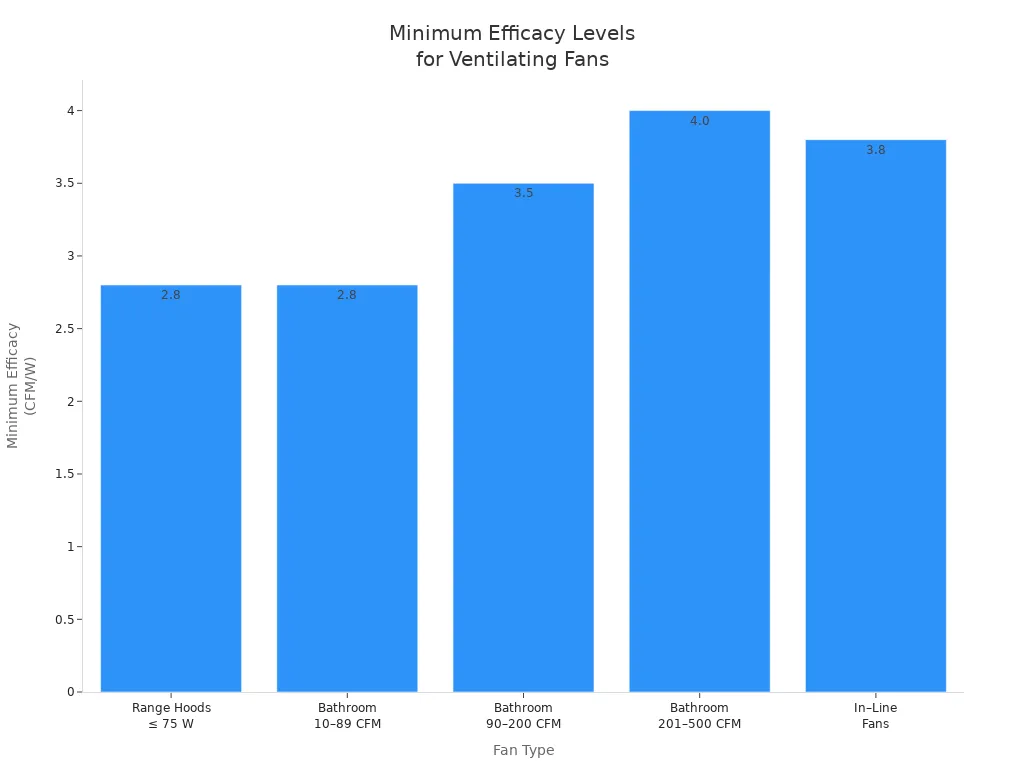
You can pick the best ventilation fan if you follow easy steps. First, look at catalogs and compare important details. Check if the fan has certifications. Always search for ENERGY STAR labels. Use tables to see which fans are quiet and efficient:
| Ventilating Fan Type | Minimum Efficacy Level (CFM/W) | Max Sound Level (Sones) |
|---|---|---|
| Bathroom Fans (10–89 CFM) | 2.8 | 2.0 |
| Bathroom Fans (90–200 CFM) | 3.5 | 2.0 |
| In-Line Fans | 3.8 | 3.0 |
If you use a step-by-step plan, your site will be organized. You will get strong warranties and easier maintenance. Keep learning about new things like IoT-enabled fans and modular designs. This helps you make smart choices that are ready for the future.
FAQ
What is a ventilation fan catalog?
A ventilation fan catalog shows you all the fan models a manufacturer offers. You can see product types, features, and technical data. Use it to compare options and find the best fan for your project.
How do I read a spec sheet?
You should look for airflow (CFM), static pressure, noise level, and energy ratings. Check installation and maintenance details. Match these numbers to your project needs for the best results.
Why are certifications important?
Certifications prove the fan meets safety and quality standards. You can trust certified products to work well and follow local rules. Look for marks like ISO, CE, or UL in the catalog.
What does CFM mean?
CFM stands for Cubic Feet per Minute. This number tells you how much air the fan moves. You need to match the CFM to your room size and ventilation needs.
How can I choose the right fan for my space?
Measure your room. Write down airflow needs. Check the catalog for fans with matching CFM and static pressure. Compare noise levels and energy ratings. Pick a fan that fits your installation spot.
What maintenance does a ventilation fan need?
You should clean fan blades, check bearings, and tighten bolts. Follow the manufacturer’s maintenance schedule. Regular care keeps your fan safe and helps it last longer.
Can I use one fan for multiple rooms?
You can use a larger fan or an inline duct fan for several rooms. Check the catalog for models that support multi-room ventilation. Make sure the fan’s airflow matches the total space.
Where can I find more information about SanLi Appliances?
Visit
