

:
| Cost Driver Type | Examples |
|---|---|
| Factory-related costs | Energy, heating and cooling, cleaning, shipping, maintenance, overhead |
| Administrative costs | General management, marketing and sales, IT support services |
| Design complexity impact | Extra costs from design choices and how many fans are made |
| Tolerance selection costs | Higher costs from tighter tolerances needing different production steps |
. You can change the first price, installation options, and even how well the fan works over time. SanLi Appliances is special because they focus on quality and global standards for ventilation fans.
You get more control over cost and product growth.
You make more profit and become more competitive.
Key Takeaways
Learn about the , like materials, labor, and how hard the design is. – Pick good materials to make fans work better and last longer, so you spend less on repairs later. – Think about using motors that save energy to pay less for electricity and help the environment. – Doing regular care, like cleaning and oiling, helps fans last longer and keeps costs down. – Keep up with news about the market and supply chain problems because these can change material prices and how easy they are to get. – Look at both the first price and the total cost over time when you pick a fan, so you save money in the long run. – Buy fans that are certified to make sure they are safe and follow rules, which can stop you from getting expensive fines or having delays. – Buy in large amounts to pay less and make better deals with suppliers.
Key Cost Drivers in Fan Manufacturing
Knowing what makes fans cost more helps you pick the right hvls fan. Every step, like picking materials or putting the fan together, changes how much you pay and how good the fan is later. Let’s look at the main things that change the price.
Material Cost Factors
Metals and Plastics
Material choices are a big reason hvls fans cost what they do. Fans use metals like steel, aluminum, and copper because they are strong. Plastics are used for parts that need to be light or shaped in special ways. What material you pick changes how much you pay at first. It also changes how well the fan works, how long it lasts, and how much energy it uses.
Note: Picking the right material can help fans work better and need less fixing.
Sourcing and Market Fluctuations
Lately, have gone up and down a lot. Problems with getting supplies and world events make it harder to get materials. This makes fans cost more and take longer to make. If fan prices change fast, it is usually because of these problems.
Component and Parts Cost
Motors and Blades
Motors and blades are very important for how much hvls fans cost. The motor type, like AC or EC, changes how much power it uses and how loud it is. Better motors cost more but work better and save money over time. Blades need to be strong and shaped well to move air.
Companies that make their own motors can make fans work better and get good certifications.
If companies buy motors, prices can change more and profits can be smaller.
People want fans that use less energy and have good warranties, even if they cost more at first.
Suppliers add new technology and better blades to meet these needs, which can make fans cost more but also work better.
Bearings and Accessories
Bearings and accessories also change how much fans cost. The bearing type changes how loud the fan is, how often it needs fixing, and how long it lasts. Here’s a simple comparison:
| Bearing Type | Noise Level | Maintenance | Lifespan | Cost |
|---|---|---|---|---|
| Single Ball Bearing | Low and Smooth | Yes | >40,000 hours | Medium |
| 2-Piece Bearing | Low and Smooth | Yes | >60,000 hours | High |
| Normal Sleeve Bearing | Increases w/age | Essential | 30,000 hours | Low |
| Hydraulic Bearing | Silent | Oil-based | 40,000 hours | Medium |
| Fluid Dynamic Bearing | Low and Smooth | Oil-based | >50,000 hours | High |
the fan lasts and how loud it is.
Accessories like smart controls or special mounts cost more but can make the fan work better and easier to install.
Labor and Production Costs
Skilled Labor
Skilled workers are a big part of fan costs. You need trained people to build, test, and install hvls fans. Some places do not have enough skilled workers, so making fans takes longer and costs more. Special workers are needed for balancing and setting up advanced systems.
Not having enough skilled workers can slow down projects and make them cost more.
More training and higher pay make manufacturing cost more.
Automation Impact
Automation changes how much labor costs. Machines can make fans faster, better, and with fewer mistakes. This helps make more fans and keeps costs down, especially for big orders. But buying machines costs a lot at first.
Automation means you need fewer workers and can keep quality the same.
The money spent on machines saves money later by making production cheaper.
Tip: Companies like SanLi Appliances use smart machines and skilled workers to keep costs low and quality high.
Main Direct and Variable Cost Drivers Table
You can see how different things change fan costs in this table:
| Cost Driver | Description |
|---|---|
| Performance Requirements | What the fan needs for airflow, noise, and energy use. |
| Motor Technology | What kind of motor is used and how it changes cost and efficiency. |
| Material Selection | What metals and plastics are picked for strength and cost. |
| Functional Configuration | How the fan is designed and how complex it is. |
| Certification Needs | Meeting world standards and certifications. |
| Customization Degree | Special designs or features for unique projects. |
| Purchase Quantity | Buying more fans lowers the cost for each one. |
When you look at these , you see each one changes the price and how good the fan is over time. By knowing these cost drivers, you can make better choices and get the best mix of performance, cost, and productivity.
Indirect Costs and Overhead
When you look at the total price of a fan, you need to consider more than just materials and labor. play a big role in the final cost drivers. These costs come from the facility, equipment, research, and the need to meet strict standards.
Facility and Equipment
You need a modern facility and advanced equipment to make high-quality fans. Large factories use special machines for cutting, shaping, and testing. These machines cost a lot to buy and maintain. You also pay for energy, cleaning, and repairs. If you want to keep your equipment up to date, you must invest in new technology. This helps you make better fans and keep up with the latest trends. When you spread these costs over many fans, each fan carries a part of the total expense.
R&D and Innovation
Research and development, or R&D, helps you create better fans. When you invest in innovation, you can:
Improve , which lowers how much it costs to run a fan.
Make fans last longer, so you do not need to replace them as often.
Add smart features, like IoT controls, to help you save energy and improve airflow.
Meet new rules and avoid fines by designing fans that follow the latest standards.
Use new motors and aerodynamic shapes to cut down on energy bills.
Pick advanced materials that make fans more reliable and durable.
Add air quality features that help with health and safety.
R&D can raise the cost at first, but it often saves money in the long run. You get fans that work better, last longer, and need less fixing. This analysis shows that innovation is a smart way to control costs over time.
Compliance and Certifications
International Standards
You must follow strict rules if you want to sell fans in different countries. Meeting international standards means you need to pay for inspections, testing, and paperwork. Certified technicians must check your fans to make sure they are safe. If you do not follow the rules, you could face fines or even have to stop selling your fans.
Quality Control Systems
Quality control systems help you keep every fan safe and reliable. You need to pay for regular checks, cleaning, and upgrades. These systems make sure each fan meets the right standards before it leaves the factory. You also need to keep good records and train your workers. All these steps add to the cost, but they help you avoid bigger problems later.
Note: When you invest in compliance and quality, you protect your business and your customers. You also build trust in your brand.
| Overhead Area | Typical Expenses | Impact on Fan Cost |
|---|---|---|
| Facility & Equipment | Maintenance, energy, upgrades | Increases per unit |
| R&D & Innovation | New designs, testing, smart features | Raises up-front, lowers long-term |
| Compliance | Inspections, certifications, training | Adds to total cost |
When you add up all these indirect costs, you see why a full analysis is important. You get a clear picture of what goes into making a high-quality fan and how each step affects the final price.
Efficiency and Operational Cost Drivers
You can make your by focusing on efficiency. These cost drivers change how fans are made and how they work later. SanLi Appliances makes fans that save energy, make less noise, and last longer. This helps you get better results and spend less money.
Energy Efficiency in Fans
High-Efficiency Motors
High-efficiency motors use less electricity and make less heat. You save energy and pay less for power. If you pick a fan with this motor, your bills go down. You also help the environment. SanLi uses special motors that meet world rules. This means you get good performance and save money for a long time.
Airflow and Noise Optimization
Making airflow better and lowering noise makes fans nicer to use. You can pick fans with special blades and smart controls. These let you change airflow for each room. This saves more energy. Fans with demand controls and the right size also help. You do not waste energy and your space is quieter.
Note: Picking the right size and layout stops wasted energy and extra costs.
| Efficiency Improvement | Description |
|---|---|
| Demand-Controlled Ventilation (DCV) | Changes airflow when people are in the room or CO₂ is high. This saves energy. |
| Energy Recovery Systems (ERVs/HRVs) | Uses heat from old air to warm or cool new air. This makes fans use less energy. |
| Efficient Sizing | Makes sure fans are not too big or too small. This stops wasting energy and money. |
| High-Induction Diffusers | Mixes air better at lower speeds. This means fans use less energy. |
| Strategic Layout & System Selection | Puts diffusers in smart spots and picks the best system. This makes everything work better. |
Energy-saving fans help you spend less money over time.
Good systems can save a lot on energy and fixing costs.
You should , not just the first price.
Buying good, energy-saving fans gives you more value as time goes on.
Maintenance and Durability
Material Longevity
Fans made from strong materials last longer. You do not have to fix or replace them as much. This saves you time and money. SanLi uses materials that do not rust or wear out fast. Your fan works well for a long time.
Warranty and Service
A warranty helps you if something goes wrong. You do not have to pay for some repairs. Cleaning blades and oiling bearings keeps your fan working. SanLi gives good warranty and service, so you worry less and save more.
| Frequency | Task | Engineering Rationale |
|---|---|---|
| Monthly | Component Cleaning: Clean the blades, impeller, and guards. | Stops dirt from building up. This keeps the fan balanced and helps the motor and bearings last longer. |
| Quarterly | Bearing Lubrication: Apply the manufacturer-specified lubricant. | Less friction and heat means bearings last longer. Not enough oil can break bearings early. |
| Quarterly | Belt Inspection: Check tension and alignment of V-Belts and pulleys. | Makes sure power moves well and parts do not wear out too fast. |
| Annually | Full Structural & Electrical Inspection: Inspect all fasteners, welds, and electrical connections. | Finds weak spots or loose parts before they break. |
| Cost Factor | Description |
|---|---|
| Material Longevity | Stronger materials mean less fixing and replacing. This helps total cost go down. |
| Warranty Policies | Warranties protect you from surprise costs if something breaks. |
| Energy Efficiency | How much energy your fan uses is a big part of total cost. |
| Initial Purchase Price | The first price is only part of what you pay. You must think about other costs too. |
| Operational Expenditure (OpEx) | How much power your fan uses matters, especially if it runs all the time. |
You can save more by picking fans that use less energy, last longer, and have good warranties. These cost drivers help you spend less on energy and repairs. They also make your ventilation system worth more.
Market and External Cost Influences
You have to think about more than just the factory. Things outside your company can change how much a ventilation fan costs. These cost drivers can change quickly. Even if you cannot control them, they still matter for your choices and your money.
Supply Chain and Material Fluctuations
Problems in the supply chain can make it hard to get materials. If metal or plastic prices go up or down, your costs change too. Sometimes, shipping problems or world events cause delays. If you need special raw materials, prices can change even more. The table below shows how :
| Supply Chain Factor | Impact on Costs |
|---|---|
| Price volatility | Increases manufacturing costs and reduces competitiveness. |
| Supply chain disruptions | Causes delays and inflates project budgets. |
| Dependence on specific raw materials | Exposes manufacturers to geopolitical risks. |
| Fragmentation | Increases procurement complexity and costs. |
| Inconsistent quality standards | Undermines trust and reliability. |
| Limited standardization | Hampers global integration and large-scale deployments. |
Tip: You can lower risks by picking suppliers with good quality checks and by planning for delays.
Global Demand and Industrial Trends
The world market changes how much fans cost. If more people want energy-saving fans, companies must make new designs. This can make fans cost more to build. Fans now have more smart features, which can also raise the price. Sometimes, companies try to win by lowering prices. This can change what you pay. Here are some trends to know:
More people want fans that save energy, so companies spend more on new designs.
, and this can make them cost more.
Governments give rewards for energy-saving fans, which can change what people buy.
When many companies compete, prices can go down, but quality might change.
Supply chain problems can make raw materials cost more.
You should watch these trends to help you buy the right fan.
Regional Manufacturing Differences
Where a fan is made can change its price and how good it is. Different places have their own rules, costs, and ways to make fans. Some places have strict safety and energy rules. Others make fans fast or use new technology. The table below shows how :
| Region | Key Factors Impacting Cost Competitiveness |
|---|---|
| North America | Mature industrial infrastructure, strict regulatory environment, advanced ventilation systems for compliance. |
| Europe | Stringent environmental regulations, energy-efficient systems, government incentives for low-noise technologies. |
| Asia-Pacific | Rapid industrialization, pollution control regulations, demand for advanced technologies in manufacturing. |
| Latin America | Upgrading aging facilities, investment in modern ventilation systems for mining and manufacturing sectors. |
| Middle East/Africa | Demand driven by oil and gas operations, investment in advanced systems for safety and efficiency in construction projects. |
Note: You can get the best deal if you know how different regions affect the fan you pick.
These show you need to look at everything. If you stay informed, you can make better choices and keep your costs under control.
Fan Types and Cost Comparison
Centrifugal vs. Axial Fans
You will find two main types of fans in most ventilation systems: centrifugal and axial. Each type works differently and affects your energy bills and long-term savings. Centrifugal fans push air using a spinning wheel, while axial fans move air along the same line as the fan blades.
Here is a table that shows how different centrifugal fans compare in and energy use:
| Fan Type | Efficiency | Input Power | Energy Use/Year | 10-Year Energy Cost | 10-Year Savings |
|---|---|---|---|---|---|
| Forward Curved | 60% | ~1.37 kW | 10,960 kWh | $13,150 | — |
| Backward Curved | 82% | ~1.00 kW | 8,000 kWh | $9,600 | $3,550 |
In a real project at a distribution center in Dallas, using 30 backward curved fans instead of forward curved ones saved over $100,000 in ten years. You can see that choosing the right fan type can make a big difference in your energy bills.
The upfront cost gap between forward and backward curved fans ranges from $100 to $400 per unit.
Energy savings can pay back the extra cost in just one or two years if your fans run all day.
Custom vs. Standard Fans
You may need a custom fan for a special project, or you might choose a standard fan for a regular job. Custom fans fit unique spaces or needs, but they usually cost more, especially if you order only a few. Standard fans use common sizes and features, so they cost less because factories make them in large numbers.
| Factor | Custom Fans | Standard Fans |
|---|---|---|
| Production Volume | Higher cost per unit for small orders; discounts for bulk orders | Lower cost due to mass production |
| Design Complexity | Increased cost for unique sizes, materials, and advanced designs | Fixed sizes and features, lower cost |
If you want a fan with special features or sizes, expect to pay more. If you choose a standard fan, you save money and get faster delivery.
OEM/ODM and Private Label Options
You can also pick OEM (Original Equipment Manufacturer), ODM (Original Design Manufacturer), or private label options. These choices affect how much you pay and what you get. OEM and ODM options let you add your own brand or ask for special features. This can change the cost based on how many fans you order and how much you want to customize.
The pricing structure depends on:
How much you want to customize your fan.
The number of fans you order at once.
The level of design or branding you need.
If you order more fans or keep the design simple, you can lower your cost. If you want a unique design or your own brand, you may pay more, but you get a product that stands out.
Choosing the right fan type and buying option helps you control your budget and meet your project needs. Always think about both the upfront price and the long-term savings.
Total Cost of Ownership in Ventilation Fans
When you pick a ventilation fan, do not just look at the price. The shows what you really pay over time. This way, you can compare fans and make better choices.
Upfront vs. Lifecycle Costs
There are two main costs for a fan. The first is the upfront cost. This means the price you pay to buy, install, and set up the fan. The second is the lifecycle cost. This includes energy bills, repairs, and other costs while you use the fan. :
| Cost Type | Description |
|---|---|
| Upfront Costs | Includes the purchase price of the fan, installation, and commissioning. |
| Lifecycle Costs | Encompasses energy consumption, maintenance, and other operational factors contributing to total cost. |
If you only think about the first price, you might miss other costs. Looking at the whole lifecycle helps you see all the money you will spend. You can find out what makes the fan cost more or less over many years.
Energy and Maintenance Savings
Saving energy and fixing fans less often is important. In one real building, adding VFDs to HVAC fans . This saved $54,900 every year. Smart choices like this can save you money and help the planet.
Yearly savings: $54,900 (with fewer filter changes)
Payback time for hvls fans: 2.31 years
Even small changes can save a lot. If you save 11.4% on energy, you could save about $102 each year for one fan. If you have 50 fans, you could save over $5,000 every year. These savings show why you should look at more than just the first price.
Value of Certifications and Quality
Certifications and good quality keep you safe from problems later. If you pick a fan with UL or ETL certification, you know it is safe. Certified fans come with papers that help you follow the rules and pass checks. This means you are less likely to get fines or have delays. :
| Evidence Point | Description |
|---|---|
| Product Safety | Certifications like UL and ETL ensure product safety, which reduces long-term operational risks for ventilation fan owners. |
| Compliance Documentation | Certified products come with complete compliance documentation, aiding in regulatory adherence and reducing potential legal costs. |
| Market Acceptance | Certified products are more likely to gain market acceptance, which can lower entry barriers and associated costs for businesses. |
| Inspection Approval | Products with UL or ETL certification help projects pass inspections smoothly, minimizing compliance risks during installation. |
When you pick high-quality, certified fans, you pay less over time. You also make sure your system works safely and well for many years.
Managing and Understanding Fan Costs
Tips for Buyers
You can make smart choices when you buy a fan. Start by looking for energy-efficient models. These fans use less power and help you save money on your bills. Choose fans with modern motors and LED lighting. These features lower your energy use even more.
Upgrade to to cut down on energy costs.
Use ceiling fans with your air conditioning. This lets you set your thermostat higher and still feel cool.
Pick fans with energy-saving motors and LED lights for extra savings.
Keep up with regular maintenance. Clean and check your fan often. This helps it last longer and reduces repair costs.
Plan for upgrades when needed. Newer fans often work better and cost less to run.
Tip: A well-maintained fan can last many years and keep your space comfortable.
Strategies for Manufacturers
You can control costs and improve your products by using smart strategies in manufacturing. Focus on . This helps you avoid expensive replacements. Sometimes, improving ductwork is a better choice than buying new equipment.
Analyze your system in detail. This can show hidden ways to save money.
Add variable frequency drives (VFDs) to your fans. VFDs give you more control and save energy over time.
Use creative solutions to meet your budget and still get great results.
Look for ways to improve your process. Small changes in manufacturing can lower costs and boost quality.
Note: Careful planning and system checks help you find the best cost drivers for your business.
Importance of Transparency
You need clear information to make good decisions about fans. Ask for detailed quotes and breakdowns from your suppliers. This helps you see where your money goes. When you understand the cost of each part, you can compare options and pick the best one.
| What to Ask For | Why It Matters |
|---|---|
| Detailed price quotes | Shows you the true cost |
| Warranty information | Protects you from extra charges |
| Maintenance schedules | Helps you plan ahead |
Transparency builds trust between you and your supplier. You can avoid surprises and make sure you get the right fan for your needs.
You can see that cost drivers change how much fans cost and how good they are. The table below shows how things like higher prices for materials and following rules make fans more expensive to make.
| Evidence Type | Percentage | Description |
|---|---|---|
| Regulatory Compliance | 79% | Most companies must follow air quality rules. This is very important. |
| Material Durability | 71% | Many people pick strong, rust-proof materials. This helps fans work better and last longer. |
| Raw Material Inflation | 86% | When metal and plastic prices go up, making fans costs more. |
| Willingness to Pay for Efficiency | 72% | Many buyers will pay extra for fans that save energy and make less pollution. |
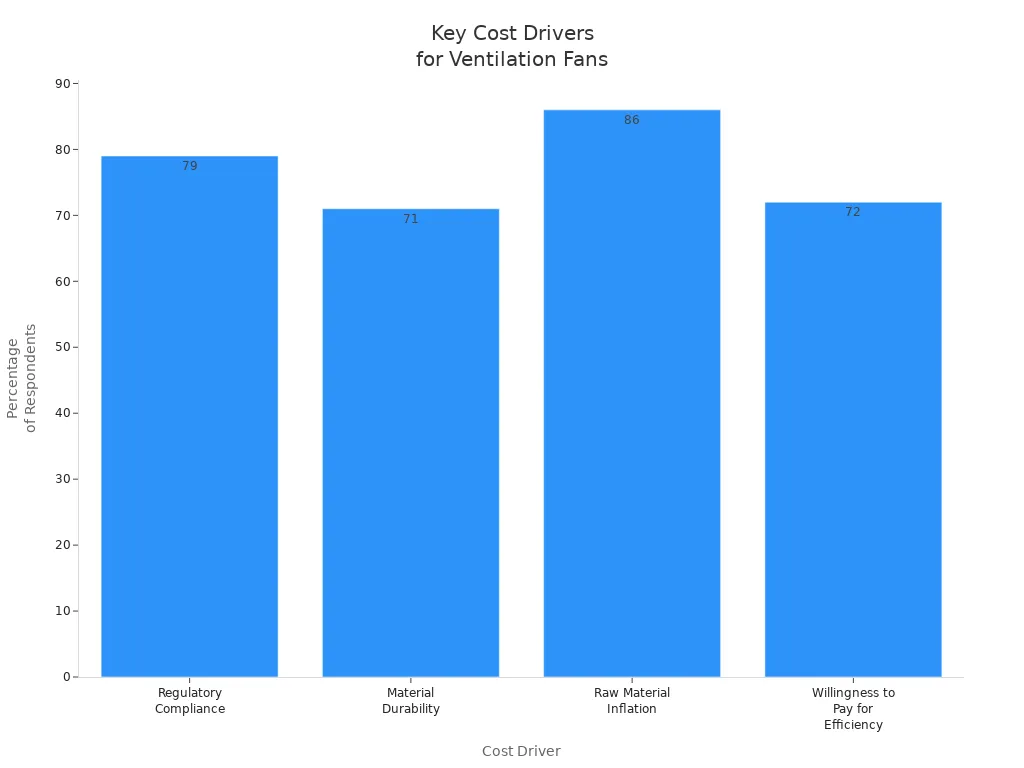
You should think about both the first price and how much you will save later when picking a fan. Choose fans that use less energy, plan to keep them working well, and buy from companies you trust. SanLi Appliances helps you by giving good service and focusing on what you need.
FAQ
What makes ventilation fans cost more or less?
You pay more for fans with better materials, advanced motors, and extra features. Simple fans with basic parts cost less. Market prices for metals and plastics also change the cost.
How do certifications affect fan prices?
Certifications like UL or CE add to the cost. You get safer, more reliable fans that meet global standards. Certified fans help you pass inspections and avoid legal issues.
Why should I care about energy efficiency in fans?
Energy-efficient fans use less power. You save money on your electricity bill. These fans also help protect the environment and often last longer.
Do custom fans cost more than standard fans?
Yes. Custom fans fit special needs or spaces. You pay more for unique designs and small orders. Standard fans cost less because factories make them in large numbers.
How does SanLi Appliances keep fan costs competitive?
SanLi uses in-house production, skilled workers, and smart machines. You get high-quality fans at a fair price. The company also offers flexible options for different projects.
What is the total cost of ownership for a ventilation fan?
You pay for the fan, installation, energy use, and maintenance. Energy-efficient and durable fans save you money over time. Always look at both upfront and long-term costs.
Can I lower my fan costs as a buyer?
Yes! Choose energy-saving models, buy in bulk, and keep up with regular maintenance. Ask for clear quotes and warranty details from your supplier.
Why do fan prices change in different regions?
