
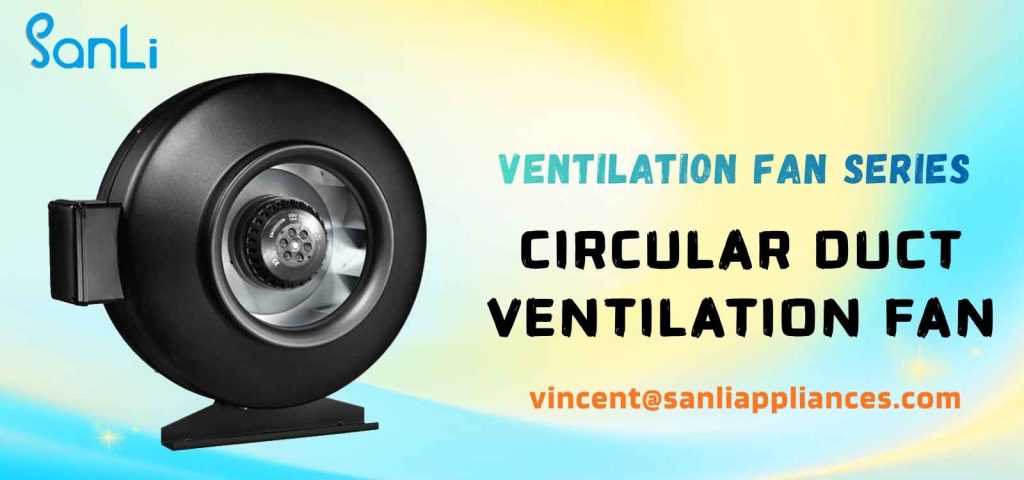
Split inline duct fans deliver targeted, high-efficiency air movement in basement ventilation projects where natural airflow is limited and moisture control is critical. At SanLi Appliances, we manufacture these systems in our Foshan factory to help brand owners, product managers, and sourcing professionals achieve reliable indoor air quality while meeting strict commercial codes. Our solutions focus on quiet operation, energy savings, and long-term durability for wholesale B2B supply.
Basements in commercial and industrial buildings often trap humidity, odors, and contaminants because they sit below grade. We have seen this challenge across hundreds of projects during our 20-plus years as a ventilation fan manufacturer. Proper mechanical ventilation prevents mold growth, reduces radon accumulation, and maintains comfortable temperatures for storage, utility rooms, or finished spaces.
What Are Split Inline Duct Fans and Why Do They Matter for Basement Projects?
Split inline duct fans are compact, remotely mounted ventilators installed directly within ductwork to move air efficiently over longer runs or through complex layouts. They solve basement ventilation problems by providing consistent exhaust or supply airflow without occupying valuable wall or ceiling space.
The split design separates the motor and impeller housing, allowing flexible placement in tight mechanical rooms or above suspended ceilings. This configuration delivers higher static pressure than traditional exhaust fans, making it ideal for overcoming duct friction in multi-level commercial buildings.
We recommend these fans when basements exceed 1,000 square feet or require continuous ventilation rates of 0.35 air changes per hour or higher. Their mixed-flow impeller technology combines axial and centrifugal advantages for superior airflow at lower noise levels.
Common Pain Points in Basement Ventilation Projects
Basement spaces suffer from persistent high relative humidity that often exceeds 60 percent, creating ideal conditions for mold and mildew. Poor air exchange also allows radon gas to accumulate, a known health risk in many regions.
Distributors and facility managers frequently report musty odors, condensation on pipes, and uneven temperatures that affect stored goods or worker comfort. Regulatory inspections can flag non-compliant systems, delaying project approvals or occupancy.
Energy inefficiency is another frequent complaint. Older exhaust-only setups waste power and fail to balance pressure, pulling in unconditioned outdoor air through cracks.
How Split Inline Duct Fans Address These Challenges
Split inline duct fans provide powerful, balanced air exchange that directly lowers humidity and dilutes contaminants. By exhausting stale air at rates of 200 to 1,200 CFM depending on model size, they maintain relative humidity between 40 and 60 percent—the range proven most effective for mold prevention.
These units install inline with existing ductwork, allowing precise placement near moisture sources such as laundry areas or mechanical equipment. Variable-speed EC motors (electronically commutated) adjust output to real-time demand, cutting energy use by up to 70 percent compared with single-speed AC motors.
Key commercial benefits include:
Reduced static pressure losses through optimized backward-curved blades
Quiet operation below 1.0 sone for occupied spaces
Easy integration with timers, humidistats, or building automation systems
Corrosion-resistant housings suitable for damp indoor/outdoor transitions
For B2B partners seeking wholesale options, these fans support customization in voltage, duct diameter, and control interfaces to match specific project requirements.
When designing comprehensive systems, review the essential of bathroom ventilation fans in building standard to align basement solutions with overall building codes.
Technical Specifications and Selection Criteria
Selecting the right split inline duct fan requires matching CFM, static pressure, and noise ratings to basement volume and duct layout. Our DPT Series Quiet High Airflow Split Duct Ventilation Fan exemplifies these capabilities with models sized from 4 to 12 inches.
| Model Series | Duct Diameter (in) | Max CFM | Static Pressure (in. wg) | Noise (sones) | Power (W) | Key Feature |
|---|---|---|---|---|---|---|
| DPT-4 | 4 | 250 | 0.8 | 0.8 | 35 | Compact for small utility rooms |
| DPT-6 | 6 | 450 | 1.2 | 1.0 | 65 | Balanced for mid-size basements |
| DPT-8 | 8 | 750 | 1.5 | 1.2 | 110 | High static for long runs |
| DPT-10 | 10 | 1,100 | 2.0 | 1.5 | 180 | Industrial-grade efficiency |
Bold key phrases highlight selection priorities: high static pressure overcomes duct resistance, low sone ratings ensure acoustic comfort, and EC motor technology delivers variable-speed precision with minimal energy draw.
We advise calculating required airflow as basement volume in cubic feet multiplied by desired air changes per hour (typically 2–4 ACH for storage or 0.35 continuous for habitable space). Always factor in equivalent duct length and fittings when sizing.
Installation Best Practices for Basement Projects
Proper installation ensures maximum performance and longevity. Begin by mapping the duct run to minimize bends and maintain straight sections where possible. Mount the fan on vibration-isolating brackets to prevent noise transmission through the structure.
Connect with sealed, insulated flexible duct or rigid metal to reduce condensation. Install backdraft dampers at the termination point to prevent reverse flow. Wire to a dedicated circuit with humidistat or timer controls for automatic operation.
Factory floor insight: Our QA team routinely finds that misalignment by even 5 degrees during installation increases vibration and shortens bearing life. Always use a laser level for precise alignment in split-housing models.
For complementary ceiling-mounted options in adjacent spaces, explore our ceiling exhaust fan buying guide for improved air quality.
Compliance with International Standards and Certifications
Split inline duct fans must meet ASHRAE Standard 62.2 for residential and light-commercial ventilation, which specifies minimum continuous rates and filtration levels. Many jurisdictions also reference the International Mechanical Code (IMC) Chapter 4 for ducted systems.
Our products carry ISO 9001 quality management, CE marking, UL listing, RoHS compliance, and ETL certification. These ensure safe, efficient operation across global markets and simplify import documentation for wholesalers and distributors.
Recent 2025–2026 updates to ASHRAE 62.2 emphasize MERV 11 filtration and humidity control below 60 percent dew point during unoccupied periods. Our EC motors and integrated controls help projects achieve these requirements without oversized equipment.
Real-World Case Study: Commercial Basement Retrofit Success
A European distributor we supply installed 18 units of our DPT-8 series in a 12,000-square-foot multi-tenant basement complex in 2025. The project addressed chronic humidity issues that previously caused mold complaints and elevated radon readings above 4 pCi/L.
Post-installation monitoring showed relative humidity stabilized at 48 percent and radon levels dropped below 1.5 pCi/L—well under EPA action thresholds. Energy consumption fell 62 percent compared with the legacy system, delivering payback within 18 months through reduced dehumidifier runtime and HVAC load.
This outcome aligns with broader industry data showing mechanical ventilation systems reduce moisture-related callbacks by over 40 percent in finished below-grade spaces (industry reports 2025).
Factory Insights and Expertise from SanLi Appliances
As a veteran manufacturer, we conduct full-factory audits on every production batch. One insider tip few specifiers know: inspect the impeller balance certificate before installation. Even minor imbalance at high RPM can amplify noise in long duct runs.
Our R&D team optimizes air-flue geometry for each model to achieve peak efficiency at typical basement static pressures of 0.5–1.5 inches water gauge. This attention to detail separates our products from generic imports that often underperform after six months of continuous duty.
Trade-offs, Limitations, and Risks of Low-Cost Suppliers
While budget fans may appear attractive, they frequently use brushed AC motors that consume more power and fail prematurely in humid environments. Noise levels can exceed 3.0 sones, violating commercial acoustic requirements and triggering tenant complaints.
Common risks include inadequate sealing leading to air leaks, poor corrosion resistance in damp basements, and lack of variable-speed capability that wastes energy during low-demand periods. Warranty claims rise sharply with unbranded units, increasing total ownership cost.
We openly discuss these trade-offs so partners can specify confidently. Our rigorous testing— including 1,000-hour salt-spray and continuous-run endurance—mitigates these risks while maintaining competitive wholesale pricing.
Selecting and Sourcing Split Inline Duct Fans for Wholesale Business
Start wholesale sourcing by reviewing full product catalogs and requesting samples for laboratory testing. Focus on suppliers offering private labeling, custom voltage options, and rapid prototyping for new building standards.
Visit our products or ventilation fan manufacturer pages to explore hot-selling axial and centrifugal lines that pair perfectly with split inline models. For immediate scalability, browse axial fan manufacturer and centrifugal fan manufacturer collections.
To accelerate market entry, consider our high-efficiency ventilation system solution for applications that bundles split inline fans with complementary ceiling units like the BPT Series Energy Efficient Ceiling Mounted Ventilation Fan.
For deeper guidance on system design, consult bathroom exhaust fan innovations that make your life easier and why need to cooperative with ventilation fan manufacturer. Professional specifiers also benefit from choosing the right advices for ventilation fan solutions.
Frequently Asked Questions
What CFM rating should I specify for a 2,000-square-foot basement? Calculate 2–4 air changes per hour based on usage. A typical 2,000 cu ft basement requires approximately 67–133 CFM continuous, but we recommend sizing to peak demand with variable-speed capability.
Can split inline duct fans handle outdoor exhaust terminations? Yes, when equipped with weatherproof louvers and backdraft dampers. Our models feature IP44-rated housings suitable for protected outdoor connections.
How do these fans compare to centrifugal inline units for basements? Split inline mixed-flow designs offer higher efficiency at medium static pressures and lower noise, while centrifugal models excel in very high-pressure applications. Review project specifics with our engineering team.
What maintenance schedule ensures maximum lifespan? Inspect and clean impellers every 12 months. EC motors require virtually no brush replacement, extending service intervals to 5–7 years under continuous duty.
Do split inline duct fans meet current radon mitigation guidelines? When installed as active soil depressurization or general ventilation, they contribute significantly. Pair with sub-slab suction for high-radon zones per EPA recommendations.
Are custom colors or branding available for distributors? Yes. We support OEM/ODM programs with minimum order quantities that suit both established brands and emerging wholesalers.
Conclusion and Next Steps
Split inline duct fans represent a proven, high-ROI solution for basement ventilation challenges in commercial and industrial projects. Their compact design, energy efficiency, and compliance features make them the preferred choice for forward-thinking B2B partners worldwide.
To explore our full range and discuss project specifications, visit SanLi Appliances blog and resources for additional technical guidance. For a quick quote or technical questions, send an email to sanliappliances@gmail.com.
To expand your knowledge, check these related resources:
For authoritative external references on ventilation standards:
We at SanLi Appliances remain committed to delivering trustworthy, expert-engineered ventilation solutions that protect your projects and your customers’ environments. Contact us today to begin your next successful basement ventilation initiative.
